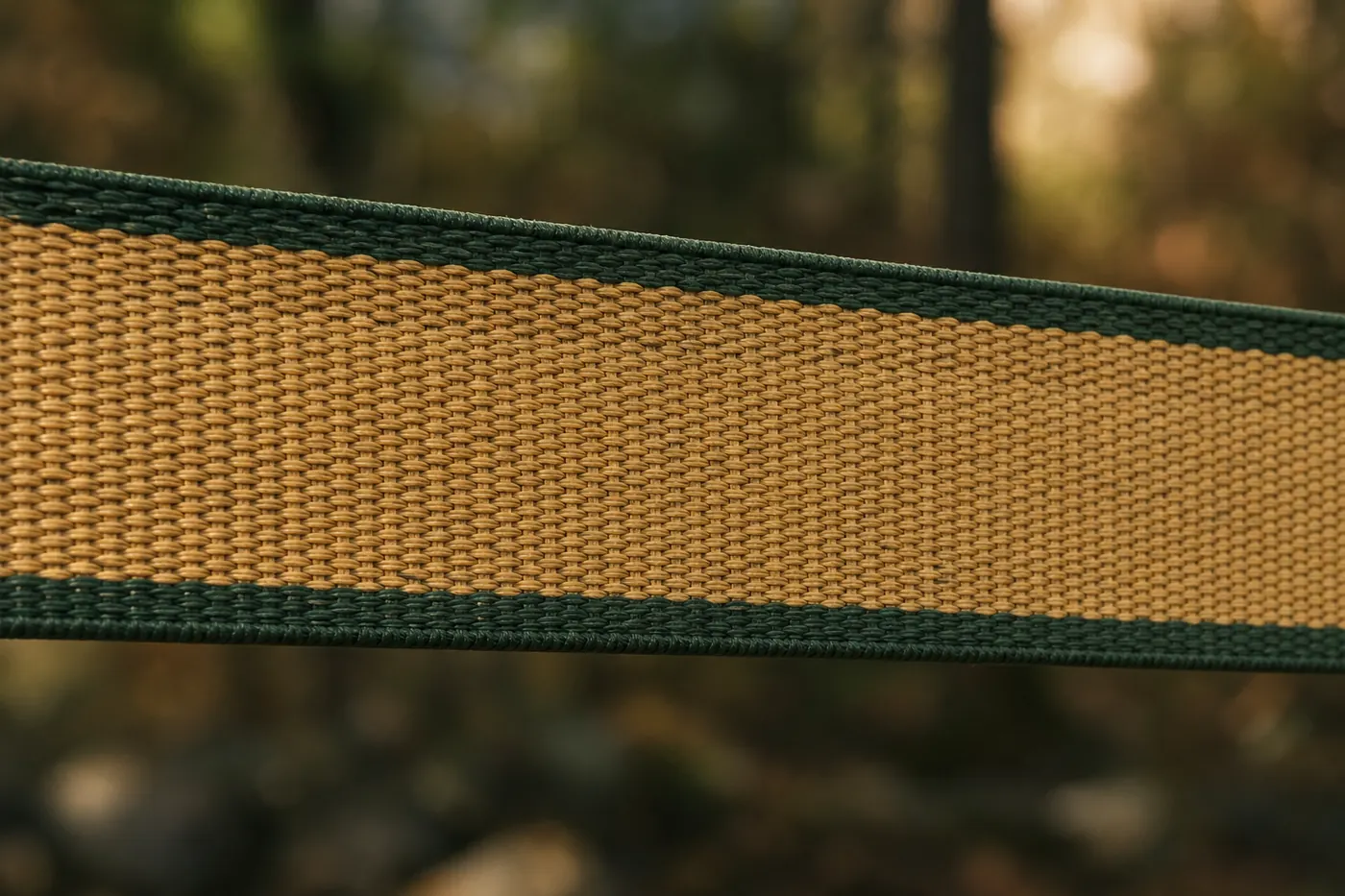
Webbing is the part you stand on, and it does more to determine how a slackline behaves than anything else in the kit. Three properties matter: how wide it is, what it is made of, and how it is woven.
Width: 50mm or 25mm
This is the first fork in the road, and for a beginner it is not a close call.
| 50mm (2 inch) | 25mm (1 inch) | |
|---|---|---|
| Feel underfoot | Broad and stable; the line resists rolling under the foot | Narrow and lively; rolls and responds to small movements |
| Learning on it | Much easier | Noticeably harder |
| Bounce | Damped, less spring | Springy — the reason trick lines use it |
| Typically used for | Beginner kits, park lines, general use | Tricklining, longlining, highlining |
| Ratchet kits available | Very common | Less common; often rigged with pulleys |
The short version: start on 50mm. Move to 25mm when you have a reason to, and you will know what the reason is when you have it.
Material: nylon or polyester
Both are strong enough. The difference is stretch.
Nylon
Nylon stretches more under load. On a line, that reads as bounce and spring — energy returned when you load it. That is desirable for tricks and jumping, and it is forgiving of a slightly imprecise landing. It also means a nylon line creeps as it settles and needs re-tensioning during a session, and it absorbs water, which temporarily changes how it behaves.
Polyester
Polyester stretches considerably less. A polyester line feels more static and more precise, holds its tension better through a session, and is less affected by damp. It is the usual choice as lines get longer, where the stretch in nylon would turn into an unmanageable amount of sag.
A reasonable rule of thumb. Short lines and jumping favour nylon. Long lines and precision favour polyester. Most 50mm beginner kits are polyester or a blend, which is a sensible default.
Weave: flat or tubular
Flat webbing is a single woven layer. It is what nearly all slackline webbing is, it lies predictably on the foot, and it is what you should expect in any kit sold for the purpose.
Tubular webbing is woven as a flattened tube. It is common in climbing, where it is used for slings and anchors, and you will occasionally see it suggested for slacklines. It behaves differently, it can roll underfoot, and it is not what modern slackline kits use.
Do not substitute climbing or cargo equipment. Climbing rope is designed to stretch and absorb a fall, which is the opposite of what a slackline needs. Cargo ratchet straps from a hardware shop are not rated or constructed for this and have failed in use. Buy webbing sold as slackline webbing.
Reading the specification
- Breaking strength in kN. A minimum standard rather than a feature. Any reputable slackline webbing will be far stronger than a low line requires.
- Stretch at load, sometimes given as a percentage at a stated force. Lower means a more static line. This is the number that actually distinguishes webbing, and it is the one most often left off the box.
- Edge finish. Bound or heat-sealed edges fray less over time.
Looking after it
Keep webbing off abrasive surfaces, especially grit and tarmac, which cut fibres invisibly. Dry it before storing it. Keep it out of prolonged sunlight, since ultraviolet degrades both nylon and polyester. Inspect the whole length for cuts, fuzzing and glazing before each session, and retire webbing that has been cut, chemically contaminated or shock-loaded over a sharp edge.
Next, the part of the system most likely to hurt you.
Ratchets and tensioning