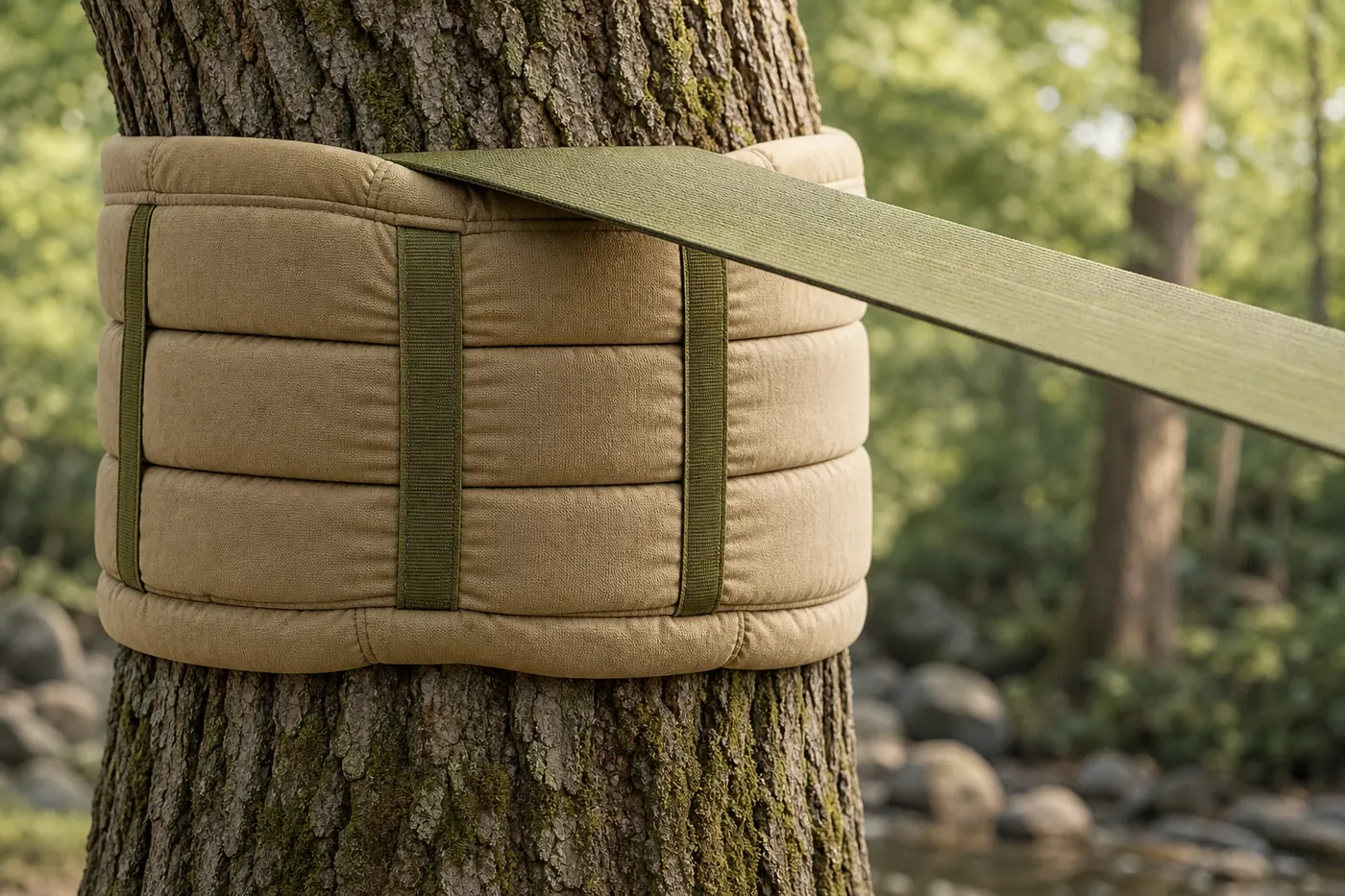
Two separate things are going on at the anchor. One is whether the tree survives you. The other is whether you survive the tree. Both are worth getting right, and the second is the one that can hurt you.
Why bare webbing damages a tree
The living part of a trunk is a thin layer just beneath the bark called the cambium. It is what moves water and sugars up and down the tree, and it is only a few millimetres thick. Everything inside it is structural deadwood.
A tensioned slackline concentrates a very large force onto a narrow band of that layer. Bare webbing under tension abrades bark and crushes the cambium beneath it. The tree does not die that afternoon — it dies slowly, over seasons, as a girdled band fails to carry nutrients. Repeated rigging in the same spot by many people is how popular park trees are killed.
This is why parks care. Most UK parks that permit slacklining require tree protection as a condition. Some have banned slacklining outright after losing trees. Using protection is the thing that keeps sites open for everyone.
What counts as protection
The job is to spread the load over a wider band of trunk and to put a sacrificial layer between the webbing and the bark.
- Purpose-made sleeves. Padded wraps sized for the job. Simplest and most reliable.
- Carpet offcuts or thick felt. The traditional improvisation, and genuinely effective if thick enough and wide enough.
- Foam pipe lagging or a folded mat. Works, but compresses and needs enough thickness to still be doing something under load.
What does not work: a thin towel, a single layer of cloth, or cardboard, all of which crush to nothing under tension and give a false sense of having done something.
Wrap generously — wider than the webbing, all the way around the contact area — and check after tensioning that the protection has not slid or bunched and left bare bark exposed.
Choosing a tree you can trust
This is the safety-critical half.
- Girth. A commonly used minimum is about 30cm diameter at the point you are rigging — roughly a trunk you cannot get your hands around. Thinner trees flex, and young trees can be pulled over.
- Health. Avoid anything dead, visibly diseased, fungal at the base, hollow-sounding, or with bark falling away. A dead tree can fail without warning under load.
- Roots. Look at the ground. Heaved soil, exposed roots or a lean that has recently changed all suggest a tree that is not well anchored.
- Overhead. Look up, properly. Dead branches — widowmakers — come down when a trunk is loaded and vibrating. This is the hazard people forget.
- Height of the wrap. Rig low on the trunk. The higher up you attach, the more leverage you apply to the tree.
If in doubt, walk away. There is always another tree, another day, or another park. An anchor failure is the worst thing that can happen on a slackline, and the warning signs are often visible to anyone who takes a minute to look.
When there are no suitable trees
- Slackline frames and A-frames. Purpose-built, freestanding, and increasingly common. The right answer for a garden without mature trees.
- Ground anchors. Screw or stake systems rated for the load. Specialist equipment, used properly.
- Structural posts, only where you know what is underneath them and that they are engineered for a horizontal pull.
Not acceptable: fence posts, lamp posts, goalposts, play equipment, garden furniture, vehicles, or anything else whose construction you are guessing at.
Where you are allowed to rig
Rules vary by local authority and by individual park. Many UK parks allow it with tree protection; some restrict it to certain areas; a few prohibit it. On private land you need the landowner's permission. It is worth checking your own council's parks policy before assuming, and worth being conspicuously careful with trees in public — the activity's reputation locally tends to be decided by whoever was seen last.
That is the full set. The articles go further into technique and setup.
Read the articles