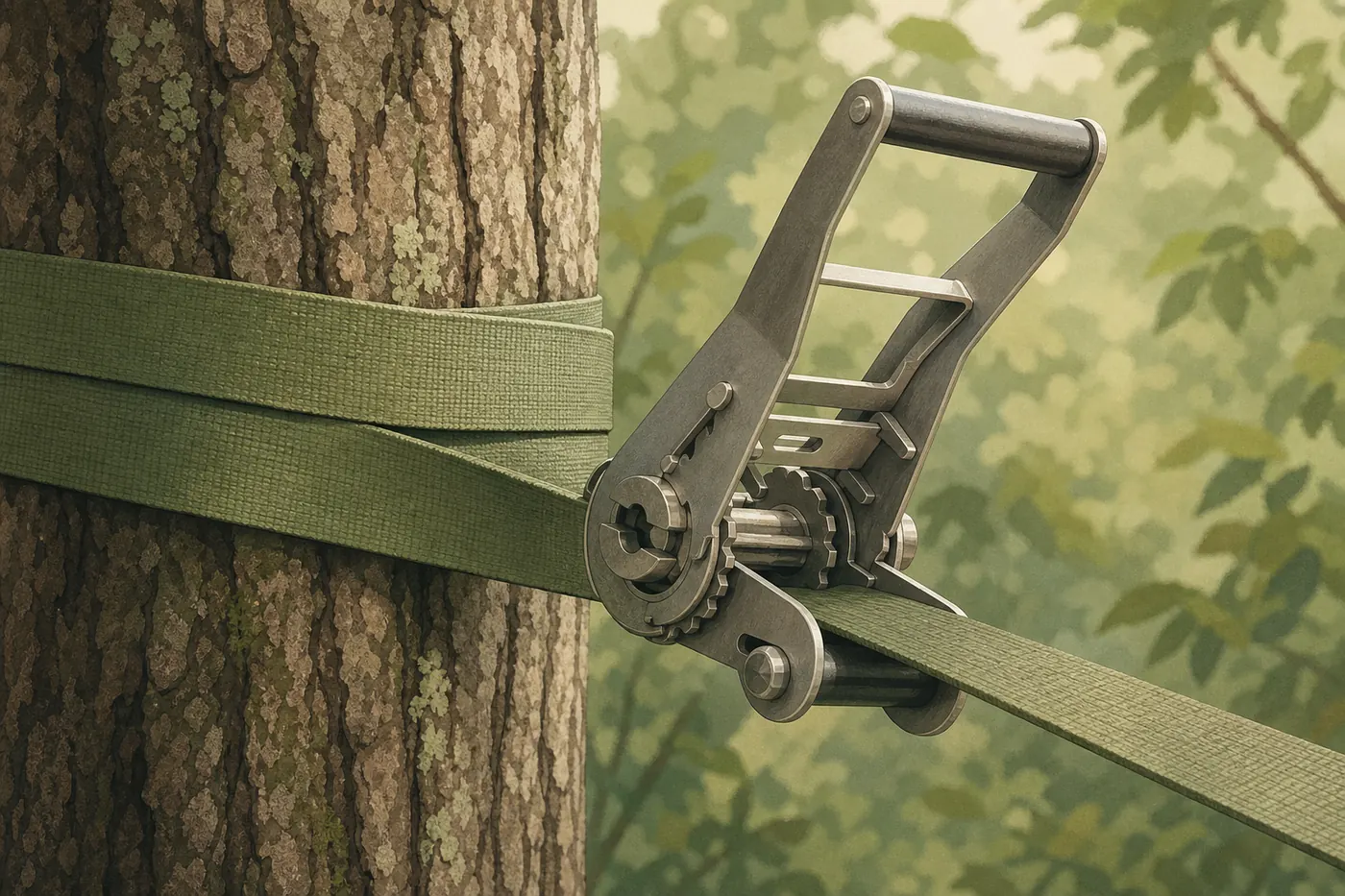
The ratchet is the component that turns a loose strap into something you can stand on. It is also the component most likely to injure you, and the one most likely to be the weakest link in the system.
How it works
A ratchet is a spool with a toothed gear and a pawl. Webbing feeds through a slot in the spool; cranking the handle winds webbing onto the spool and the pawl stops it unwinding. Each stroke of the handle adds tension and the pawl holds it.
Releasing is the part people get wrong. The release lever disengages the pawl so the spool can spin freely — and a tensioned line will spin it violently.
Release under control. Keep a firm grip on the handle as you disengage the pawl, keep your fingers out of the mechanism, and keep your face away from it. A ratchet released carelessly on a well-tensioned line can snap round hard enough to break fingers.
How much tension
Less than you think.
Beginners almost always over-tension, because a tighter line feels more stable to stand on and the ratchet makes it easy. The costs of over-tensioning are real: much higher loads on your anchors and hardware, more damage to trees, a line that is punishing to fall onto, and — if something does fail — far more stored energy released.
A good low line has a visible sag when unloaded and sinks noticeably when you step on it. If the line is drum-tight and barely moves, back it off.
Types of tensioning system
Standard ratchet
What comes in nearly every beginner kit. Simple, quick, and entirely adequate for lines up to roughly 25 metres.
Long-handled and geared ratchets
More leverage for the same effort. Useful on longer lines, and a reason to be more careful rather than less — a long handle makes over-tensioning effortless.
Pulley systems
A block-and-tackle arrangement of pulleys, usually with a rope grab and a dedicated line-locker. Pulley systems can generate and hold far more tension than a ratchet, they release in a controlled way, and they let you fine-tune. They also cost more, take longer to rig, and require you to understand what you are doing. People move to pulleys when lines get long enough that a ratchet runs out — not before.
What to look at when buying
- Rated capacity, stated separately from the webbing. This is typically the system's limit.
- Build. Pressed steel frames flex under load. A heavier, better-finished ratchet is the main thing extra money buys in a beginner kit.
- A cover or pad. Keeps the mechanism off the ground and softens the thing most likely to be hit.
- Handle length. Longer is easier, and easier to overdo.
Inspection
Before each session, check the teeth and pawl for wear or deformation, check the frame for bending or cracks, check the spring returns the pawl positively, and check the webbing where it passes through the slot — that is the highest-wear point in the whole system. Retire a ratchet that is bent, cracked, seized or missing its spring. Do not oil the gear teeth; oil attracts grit.
Next, the end of the system that holds everything up.
Tree protection and anchors