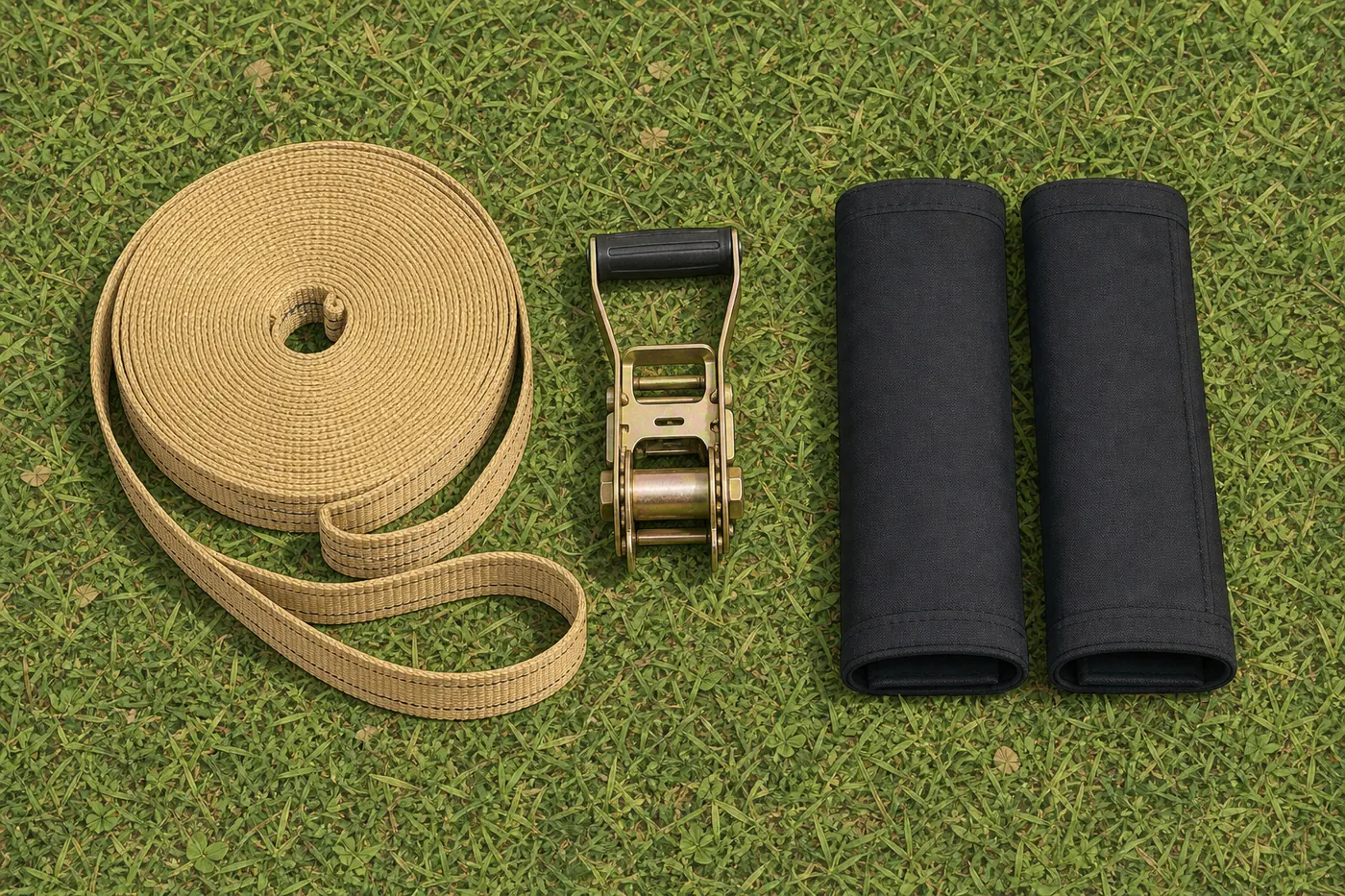
A beginner slackline kit is three things: a length of flat woven webbing, a ratchet to tension it, and something to stop the webbing damaging the trees. Nearly every entry-level kit sold in the UK is some version of that, and the differences between them are smaller than the marketing suggests.
What follows is how to read those differences.
The four numbers that matter
Width
Almost every beginner kit is 50mm — two inches — wide. That is the right choice. A wider line gives you more surface under your foot and moves less, which makes the first hour considerably less demoralising. Narrower 25mm webbing is more responsive and is what many experienced people prefer for tricks and for long lines, but it is harder to learn on.
Length
15 metres is the standard beginner length and it is a good default. You can always rig a long line short. You cannot rig a short line long.
What matters more than the number is the distance between your anchors. Around 8 to 10 metres is a comfortable learning span. Much shorter and the line is twitchy and unforgiving; much longer and it sags deeply in the middle and swings, which is a different and harder skill.
Breaking strength
You will see a figure in kilonewtons — frequently somewhere in the region of 20 to 30kN for webbing. One kilonewton is roughly 100kg of force. These numbers look reassuringly enormous, and for a low line they are. Treat breaking strength as a minimum standard that any reputable kit will clear rather than as a feature to shop on, and pay attention to the ratchet instead, which is almost always the weaker part of the system.
Ratchet capacity
The ratchet is rated separately from the webbing and it is usually the limiting component. A ratchet with a longer handle gives more leverage, which means you can reach a given tension more easily — and also that you can over-tension a line without realising how hard you are pulling.
The ratchet is the hazard. It catches fingers, and it releases suddenly if the handle is not fully closed. Keep your face away from it while tensioning, and keep children well clear of a loaded line.
What a complete first kit includes
- Main line. The webbing you stand on.
- Ratchet with its own short length of webbing. This loops the tree at one end.
- Tree protection. Padded sleeves or mats. If a kit does not include these, budget for them separately — they are not optional.
- A ratchet cover, on better kits. Worth having.
- A carry bag. Pleasant, not important.
Some kits add a second, higher line to hold while you learn. Opinions differ on whether these help or create a habit of hanging on. A friend's shoulder does the same job and lets go at the right moment.
What you do not need yet
Pulley systems, weight-rated shackles, backup lines, line-lockers and 25mm webbing are all real equipment with real uses. None of them belongs in a first purchase. They answer problems you will not have for a while, and buying them early mostly means owning equipment you cannot yet judge.
Where to set it up
Low. Knee height or a little below, over flat grass, with nothing to land on in any direction. Resist the urge to go higher: height adds nothing to the learning and a great deal to the consequences of a fall. Check overhead for dead branches, and check you are allowed to rig where you are — many UK parks permit slacklining but require tree protection, and some prohibit it entirely.
Common questions
What length slackline should a beginner buy?
A 15 metre kit is the usual starting point. You do not have to use all of it — you can rig a 15 metre line across 8 metres of space and simply have webbing left over. Buying short limits you later; buying very long does not help at the start, because a longer span sags and sways more and is harder to stand on.
How much should a first slackline cost?
Complete beginner kits — webbing, ratchet and tree protection — sit at the lower end of the market, and the main thing you are paying for as the price rises is the quality of the ratchet and the width and finish of the webbing. We do not quote prices, because they move constantly.
Do I need two trees?
You need two solid anchors roughly 8 to 15 metres apart. Healthy mature trees are the usual choice. A-frames, posts set in concrete and purpose-built slackline frames are alternatives, but improvised anchors such as fence posts, lamp posts and garden furniture are not.
Is a ratchet kit good enough, or do I need a pulley system?
A ratchet kit is the right first purchase for almost everyone. Pulley systems come in when lines get long enough that a ratchet cannot generate or hold the tension you need, which is well beyond a first season.
Can I teach myself?
Most people do. Standing on one foot while holding a friend’s shoulder, then letting go, is the whole of the first lesson. What self-teaching does not cover is rigging judgement — whether a tree is sound, whether an anchor is safe — which is where getting an experienced person to look at your setup is worth a great deal.
Next, the choice that changes how a line actually feels underfoot.
Webbing explained