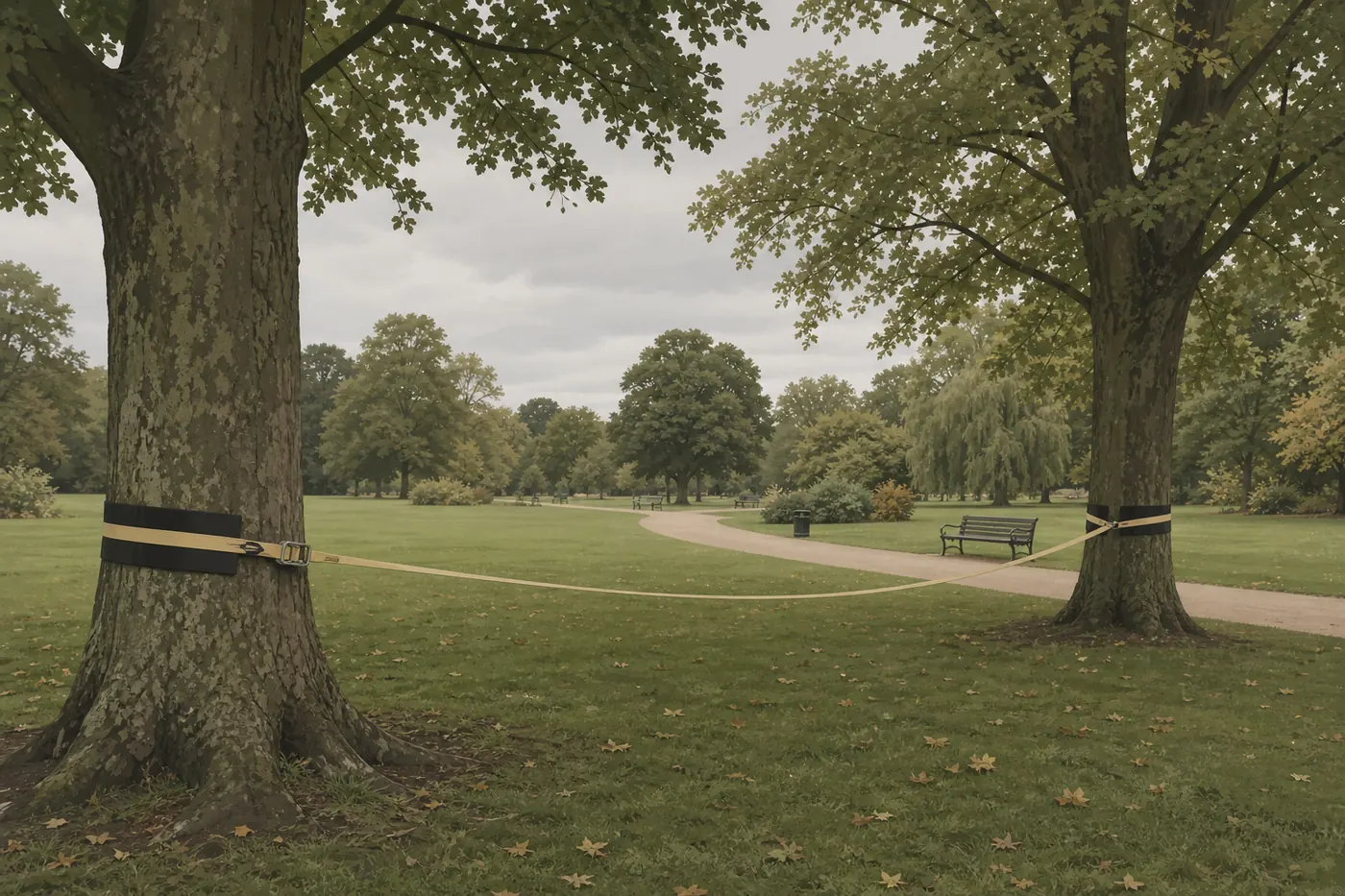
There is no national rule covering slacklining in the UK. Whether you can rig a line in a particular place depends on who owns the land and what they have decided, which means the honest answer to “am I allowed?” is almost always “it depends where you are standing”.
Here is how it actually works.
Public parks
Most parks in Britain are managed by the local council, and slacklining policy is set council by council — sometimes park by park.
Broadly, three positions exist:
Permitted with conditions. The most common. Typically the conditions are tree protection, a minimum trunk size, keeping lines low, and not blocking paths. This is a reasonable deal and worth honouring precisely.
Permitted in designated areas only. Some larger parks restrict it to particular spaces, often away from specimen trees or busy areas.
Prohibited. Usually somewhere that has lost trees to it, or where a byelaw prohibits attaching anything to trees in general.
The practical approach is to search your council’s website for its parks byelaws or its page on slacklining, and if nothing comes up, to ring the parks department and ask. That conversation takes five minutes and is a great deal better than being asked to take a line down.
Be aware that a park having no stated policy is not the same as permission. It usually means nobody has considered the question yet, and the answer you get may depend on who you ask.
National Trust, Forestry England and similar
Land managed by conservation bodies generally has tighter rules, because tree health is a core part of their remit rather than an afterthought. Assume you need to ask, and assume the answer may be no. Some Forestry England sites do permit it; policies differ by site.
Private land
Straightforward in principle: you need the landowner’s permission. With it, you are fine. Without it, rigging a line is trespass regardless of how careful you are being.
Your own garden is the simplest option of all, and the reason freestanding slackline frames exist is that most gardens do not contain two suitable mature trees.
Indoors
A growing number of climbing centres and gymnastics clubs have slacklines, often on fixed frames. This is a genuinely good way to start — the surface underneath is designed for falling onto, the setup is already correct, and there is usually someone around who knows what they are doing. It also solves the British weather problem.
Beaches, commons and public rights of way
Beaches are usually managed by the council or the Crown Estate, and the usual council rules apply. Common land is not automatically open to any activity. A public right of way grants passage, not the right to rig equipment across it, and blocking a path is a genuine problem rather than a technicality.
How not to be the problem
Slacklining’s access situation in any given town is decided largely by whether the activity is visibly careful. A few specific things matter:
- Use tree protection, every time, without exception. This is the one that closes parks when ignored.
- Choose mature, healthy trees and rig low on the trunk.
- Do not block paths, and leave room for people and dogs to pass comfortably.
- Do not leave a line unattended. A tensioned line at shin height is a hazard to anyone not expecting it.
- Take everything home, including the webbing scraps.
- Be pleasant when asked about it. A lot of people have never seen one and are simply curious. Some of them run the park.
Our guide on tree protection and anchors goes into what makes a tree suitable in the first place.
The guides cover the equipment side in more depth.
Read the buying guides