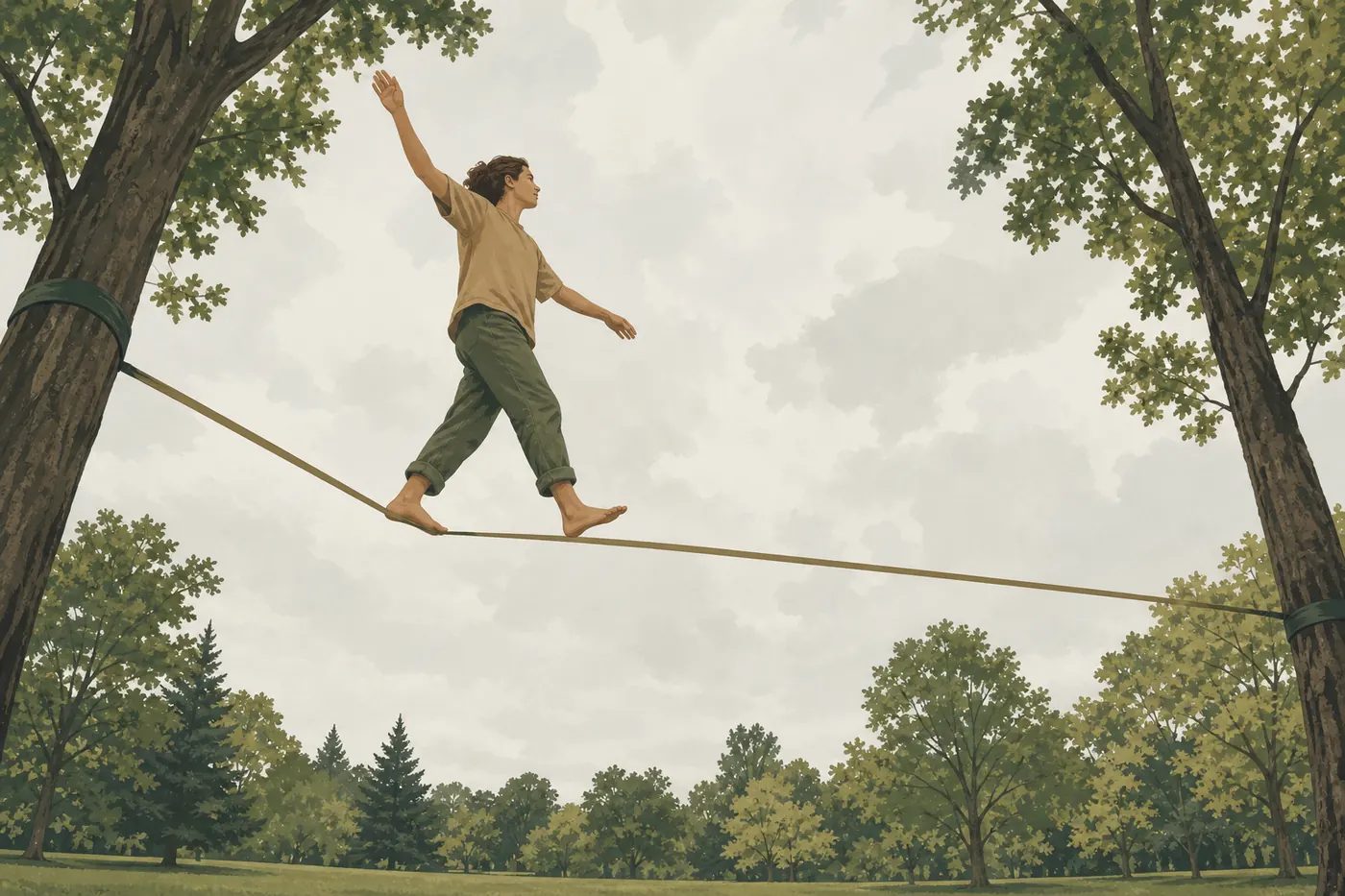
Slacklining is balancing, and walking, on a length of flat webbing tensioned between two anchors. Those anchors are usually trees. The line is typically 50mm wide, somewhere between 8 and 15 metres long for a beginner, and set low enough that falling off is uneventful.
The name describes the essential difference from tightrope walking. A tightrope is a rigid, fully tensioned cable that barely moves. A slackline is dynamic: it stretches, bounces, and swings side to side. You are not standing on a static surface, you are negotiating with a moving one. That is the whole sport.
Why it is harder than it looks and easier than it looks
Both are true, and people are usually surprised by each in turn.
It is harder than it looks because the line moves in response to you. Your first attempts will produce a violent side-to-side oscillation — the line shakes, your leg shakes, and the two feed each other. Everyone does this. It is called sewing-machine leg and it is a feature of the first session, not a sign that you lack balance.
It is easier than it looks because the damping happens quickly. Most people can stand on one foot within a session or two and take a few steps within a week of occasional practice. The skill is not strength or exceptional balance; it is learning to relax and let your body make small corrections instead of large ones.
The disciplines
Lowlining
The default. A line at roughly knee height, 8 to 15 metres, over grass. Everything else grows out of this, and most people never need anything more. If you are buying a first kit, you are buying a lowline kit.
Tricklining
Jumping, bouncing, sitting, and increasingly acrobatic moves performed on a short, tight, very dynamic line. Trick lines are usually 25mm webbing, often nylon for its spring, rigged shorter and tighter than a walking line. This is the version you have seen in videos.
Longlining
Walking lines that get progressively longer — 30 metres, 100 metres, and beyond. The physics change completely as length increases. Sag becomes enormous, the line swings like a pendulum, and the tension required exceeds what a ratchet can produce or hold, so longliners use pulley systems and low-stretch polyester webbing. It is a discipline of rigging as much as of balance.
Waterlining
A line rigged over water. Mechanically it is lowlining; practically it is lowlining where falling costs you nothing, which makes it a very pleasant way to try things you would otherwise hesitate over.
Highlining
Lines rigged at height — across gorges, between buildings, between rock towers. Highlining uses redundant anchors, backup webbing, and a leash connecting the walker to the line. It is a serious technical pursuit with mountaineering-grade equipment and consequences to match, and it is not something to approach through self-teaching or a website.
Rodeo lining
A line rigged deliberately slack, with no tension at all, so it hangs in a deep curve and swings freely. Harder than it sounds, and requires no tensioning equipment whatsoever.
Where it came from
Slacklining emerged in the climbing community in Yosemite Valley around the late 1970s and early 1980s, as something climbers did with spare webbing on rest days — initially balancing on chains in car parks, then on webbing rigged between trees. It stayed a climbers’ pastime for two decades before commercially packaged ratchet kits arrived in the late 2000s and turned it into something anyone could buy and set up in a park.
That history explains a lot about the equipment. Much of the vocabulary, and much of the hardware at the serious end, is borrowed directly from climbing.
What you need to start
A kit, two sound trees, tree protection, and somewhere flat to fall. That is genuinely all. Our guide on choosing your first slackline covers what to look for, and the safety notice covers what can go wrong.
The guides cover the equipment side in more depth.
Read the buying guides