Most of what slows a beginner down is not a lack of balance. It is a handful of specific, avoidable errors, and almost everyone makes some of them.
1. Over-tensioning the line
The most common mistake by a distance. A tighter line feels more stable, the ratchet makes tightening effortless, and so people keep cranking.
The problem is everything else that tension does. It multiplies the load on your anchors and hardware. It damages trees more. It makes the line punishing to fall onto. And if anything does fail, there is far more energy released.
A good beginner line sags visibly when nobody is on it and sinks noticeably when you step on. If it barely moves, let some off.
2. Looking at your feet
Your balance system wants a stable visual reference. Your feet, on a moving line, are the least stable thing available.
Look at the far anchor. Fix on it. This one change does more for most beginners than anything else, and it feels wrong for about a day.
3. Rigging too high
Knee height or below. The temptation to go higher is understandable and there is no upside to it — a higher line is not more impressive to learn on, it is just a longer way to fall and more likely to catch you across the shin on the way down.
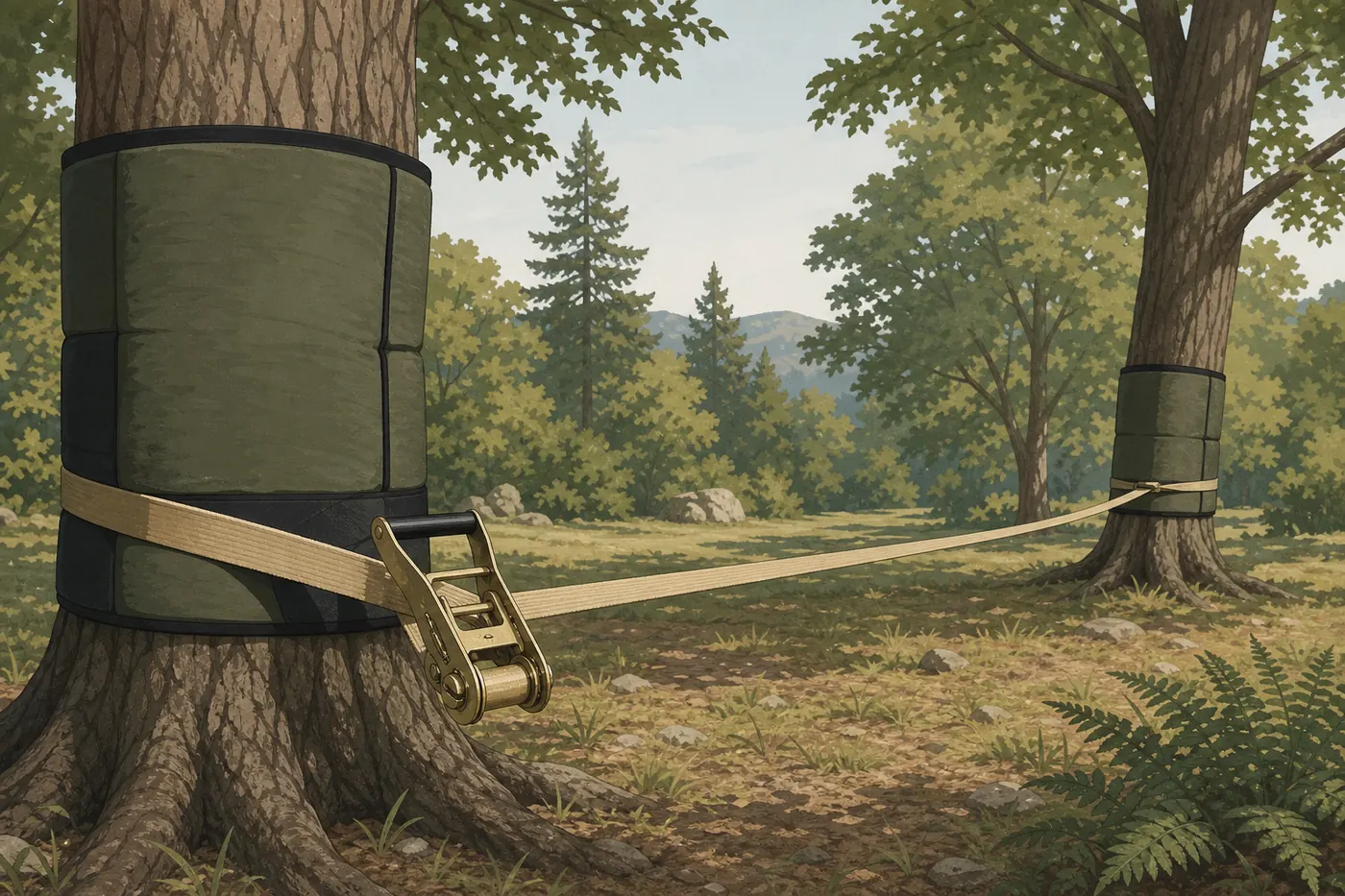
4. Skipping tree protection
Usually justified with “it’s only for an hour”. The damage is cumulative and invisible in the short term: a tensioned line crushes the thin living layer under the bark, and the tree declines over seasons rather than days.
It is also the single thing most likely to get slacklining banned in a park. Our guide covers what works — and a carpet offcut is perfectly adequate.
5. Stiff legs
Locking the standing knee transmits every movement of the line straight up through your body and straight back down into the line, which is exactly the feedback loop that produces the shaking.
Soft knee. Let it absorb.
6. Practising for too long in one go
Slacklining is neurologically demanding and the adaptation happens between sessions, not during them. Twenty focused minutes several times a week will take you further than a two-hour session at the weekend, after which you are simply tired and reinforcing bad habits.
7. Holding onto something for too long
A friend’s shoulder or a hand line is genuinely useful for the first few attempts. Beyond that it becomes a crutch, because your body learns to balance with an external reference and then has to unlearn it.
Let go earlier than feels comfortable. You will fall off more and improve faster.
8. Not checking overhead
Everyone inspects the trunk. Almost nobody looks up.
Dead branches come down when a trunk is loaded and vibrating, and a branch falling from height is considerably more dangerous than anything the line itself will do to you. Take ten seconds and look at what is above the line and above your landing area.
The one that is not a mistake
Falling off constantly. That is not a sign you are doing it wrong — it is the mechanism by which you learn. The people who progress quickly are generally the ones who have fallen off the most that week.
The guides cover the equipment side in more depth.
Read the buying guides